
Firelight and the Feeling of an Interior
There is an entire city beyond the windows, but the small flame on the coffee table gives the eye a reason to stay inside. It sits low beside the sofa, close to an open book and a thick knitted throw. The brick wall occupies much more of the image. The flame needs very little space to become part of how we read the room.
Without Camera's Various candles series, created for Tenderflame, places fire in settings with very different amounts of surrounding light. Looking across them, I am interested in the point at which a flame begins to organise a space. Its size is only part of that relationship. The background, the enclosure and the surfaces nearby all help decide how much presence it has.
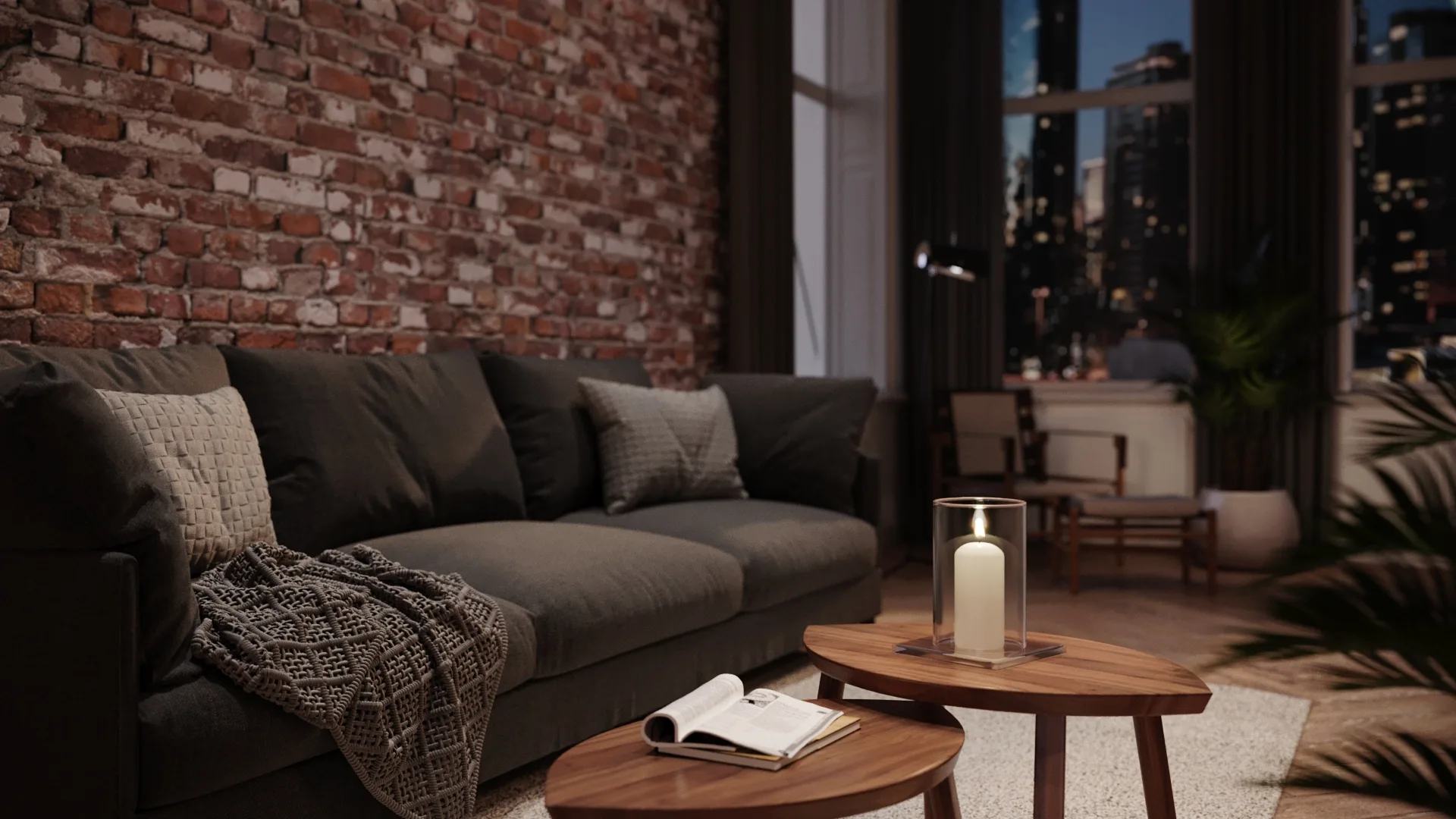
Here, the candle belongs to the small group of tables in front of the sofa. The book gives that group an ordinary purpose; the flame gives it a bright point. Farther away, the windows contain many smaller lights, softened by distance and blur. There is a readable difference between the room we could occupy and the city we can look towards.
The warmth of the scene has several contributors. The timber, red brick and knitted throw already suggest a place to settle. The candle joins those choices. Its effect is easier to understand when we recognise how much the furniture and materials are doing around it.
Give the flame a background
In the taller brick room, the fire sits within a dark vertical enclosure. The change in scale is substantial: this is an element of the wall composition, visible beyond the foreground sofa. Yet the actual flame still occupies a small portion of the view.
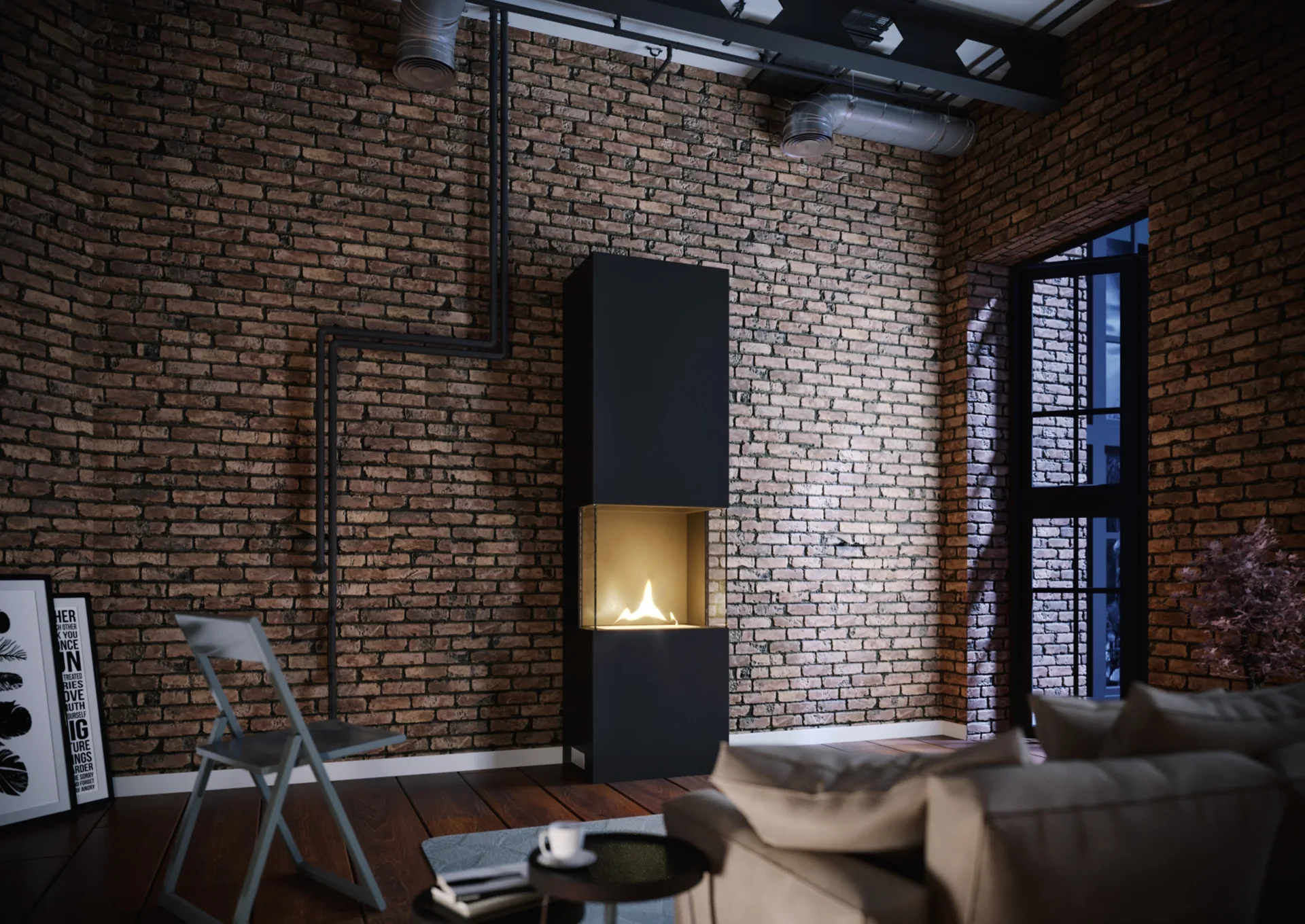
The dark surface gives the eye a pause in the brickwork. Around it, joints and uneven faces create a dense pattern; within it, a plain rectangle makes the opening easy to find. The yellow-gold interior of the recess gathers warmth immediately around the fire. Its edges tell us where that small luminous space ends.
The contrast matters more than a uniformly warm room would. A broad patch of brick to the right is much paler, and the window carries a blue tone. Those differences remain visible alongside the fire. The enclosure can hold attention while the rest of the architecture keeps its own colour and texture.
I would be careful about reading the brightness of the whole wall as firelight. The image shows a mixture of light, and the finished render does not separate its sources for us. What it does show clearly is how a dark frame can give a small flame an architectural presence. The background has been given as much compositional work as the bright object.
Look just beyond the flame
At the scale of a sideboard, the relationship becomes more intimate. A low cylindrical burner stands between a vase of roses and an open metal bowl. Behind it, framed black-and-white drawings provide broad pale surfaces where changes in brightness are easy to see.
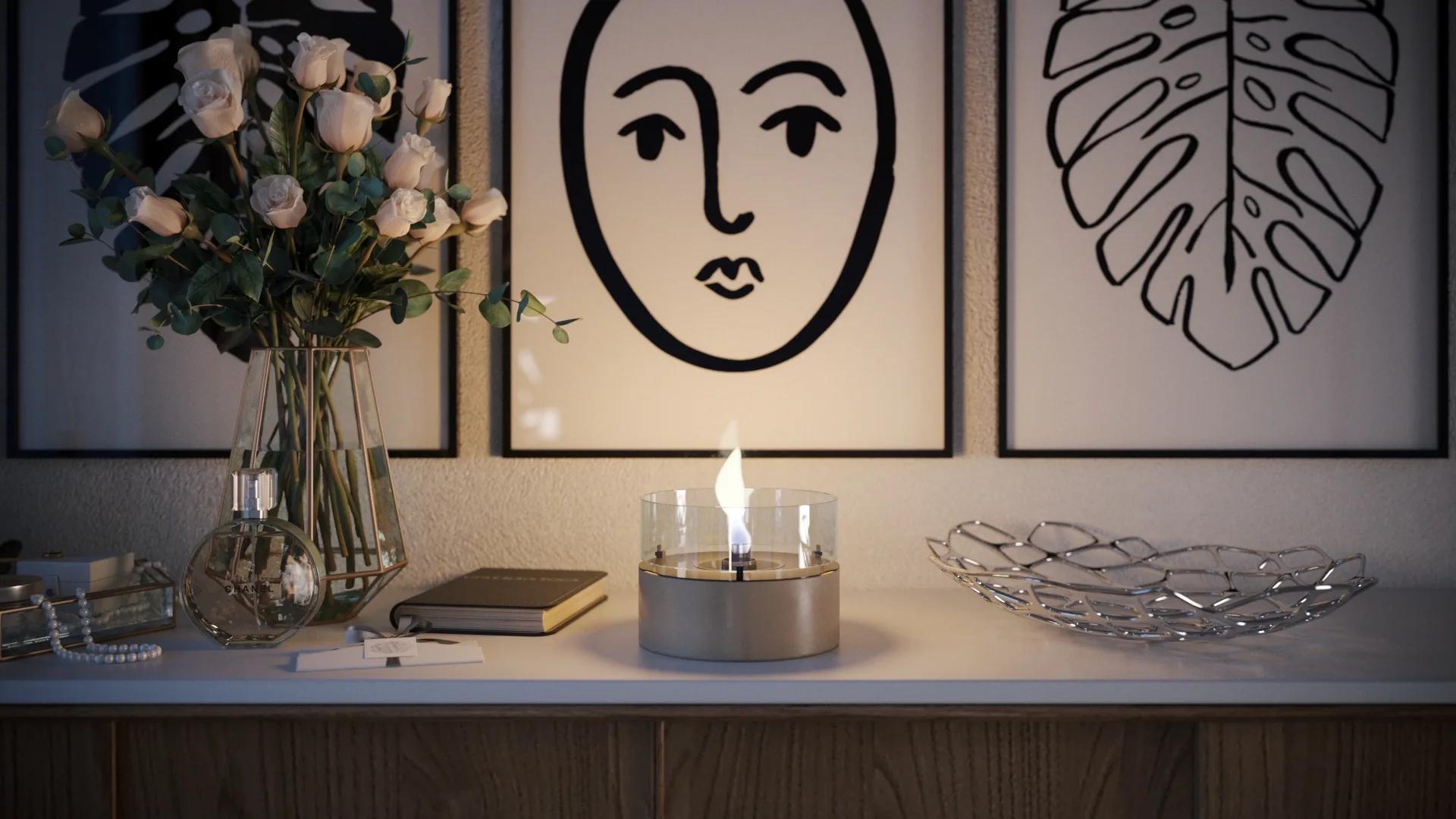
The wall close to the flame has a warmer cast than the cooler left edge of the arrangement. In the glass enclosure, brightness appears as narrow, hard-edged streaks. The wall receives a broader, softer change. These different marks help the luminous object feel connected to its setting.
There are also highlights on the vase and metal bowl. We cannot attribute every one of them to the fire, but their presence makes the scene worth looking at beyond its brightest point. Glass, metal and the textured wall each hold light differently. The flame is surrounded by surfaces that give the eye several ways to notice brightness.
That is the detail I would carry into a reading of another render: after finding the flame, look at the few surfaces beside it. A convincing sense of light involves a relationship with those surfaces. The brightest shape alone tells us much less about the room.
When the room is already bright
The bathroom puts a useful limit on the argument. Pale tiles, a white basin and the side of the bath fill much of the view. The fire stands in the foreground, but the room is already brightly lit.
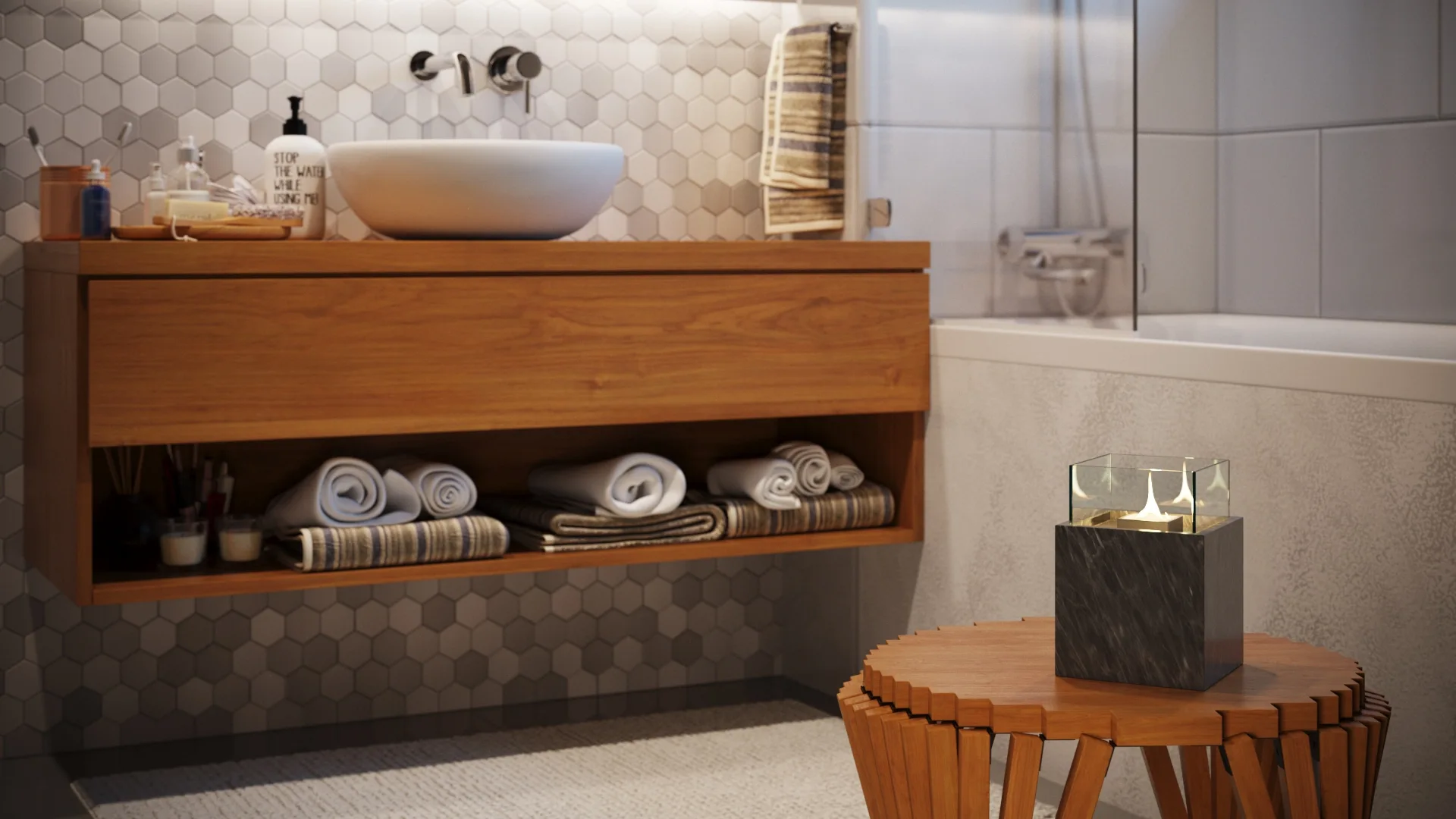
Against the pale bath, the flame has less separation than it did inside the dark fireplace. The deep colour of its base makes a strong outline, while the glass carries several bright images of the fire. The object remains distinct, although its glow does not define the atmosphere of the whole bathroom.
The surrounding room continues to hold attention: the long timber drawer, the dark recess beneath it and the rolled towels are all clearly legible. Here, fire reads as one detail within a larger arrangement. The same visual ingredient has acquired a more modest role because its neighbours have changed.
When I return to the candle beside the sofa, that modest scale feels important. The room has space to remain a room, with a book left open and windows looking elsewhere. The flame simply gives its nearer part somewhere for our attention to settle.
Visualizations by Without Camera, used with permission. Various candles is a series of product visualizations for Tenderflame, presenting candles and fireplaces in different interior settings.