
Why Some Digital Fabrics Feel Soft
The corner of the pillow extends beyond the hand, while its lower edge gathers into folds beside the opposite forearm. Between those uneven edges, the centre remains full. There is enough information here to imagine how the object might yield, even before looking closely at its fabric.
In Without Camera's Tristar Heated Electric Pillow series, the product appears held against the body, placed beneath the head and tucked behind the back. These ordinary relationships give softness a visible form. The interesting question is how much of that impression comes from the surface, and how much comes from the shape beneath it.
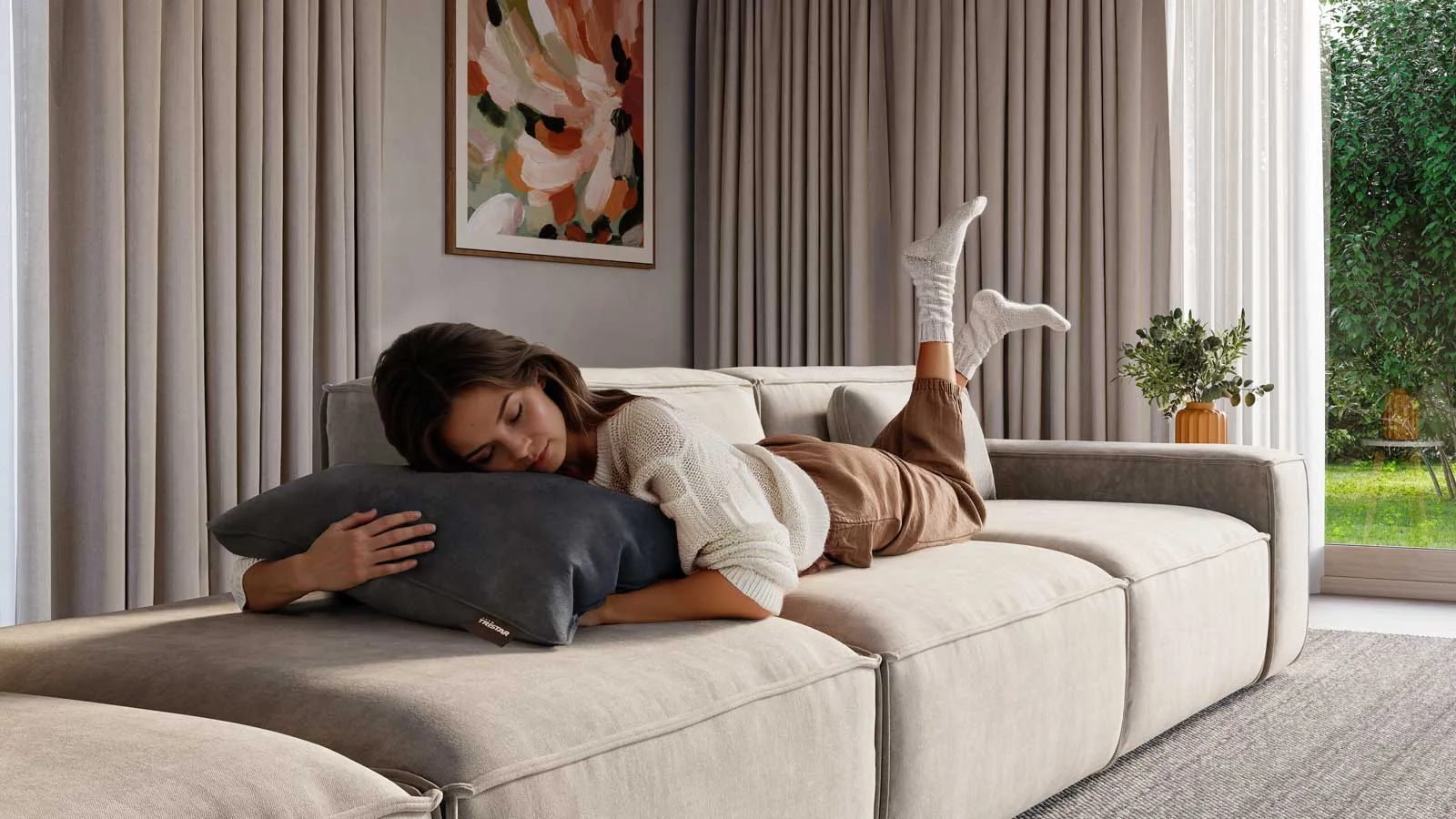
Start with the edge of the grey pillow. Its left corner narrows as it projects away from the body. Along the lower right side, deeper creases interrupt the rounded outline. The changes are local: the whole object has not collapsed into a loose bundle. There is still volume between the places where the fabric turns inward.
That balance makes the pillow persuasive. A uniformly rounded rectangle would tell us about its outline, but much less about its relationship with the person holding it. Here, the hand, forearm, head and sofa give the shape several points of reference. We can follow the places where it meets something else and where it remains free to extend.
The shadows help separate those conditions. Narrow dark areas mark the deeper folds, while broader changes in brightness describe the fuller middle. The fabric has a fine, subdued surface pattern, yet the larger shapes remain clear. At the scale of the whole image, they carry much of the impression of softness.
The sofa provides a useful neighbour. Its cushions have rounded edges too, but their repeated rectangular divisions make the furniture feel more structured. Against that regular arrangement, the pillow's uneven outline reads as something that can be gathered into the arms. Soft objects can have very different degrees of visual order.
Give the surface a scale
The cream pillow in the car introduces a more conspicuous texture. Small raised-looking clusters cover its face, while a much larger hollow crosses the middle near the lower hand. Those two sizes of detail can be read separately.
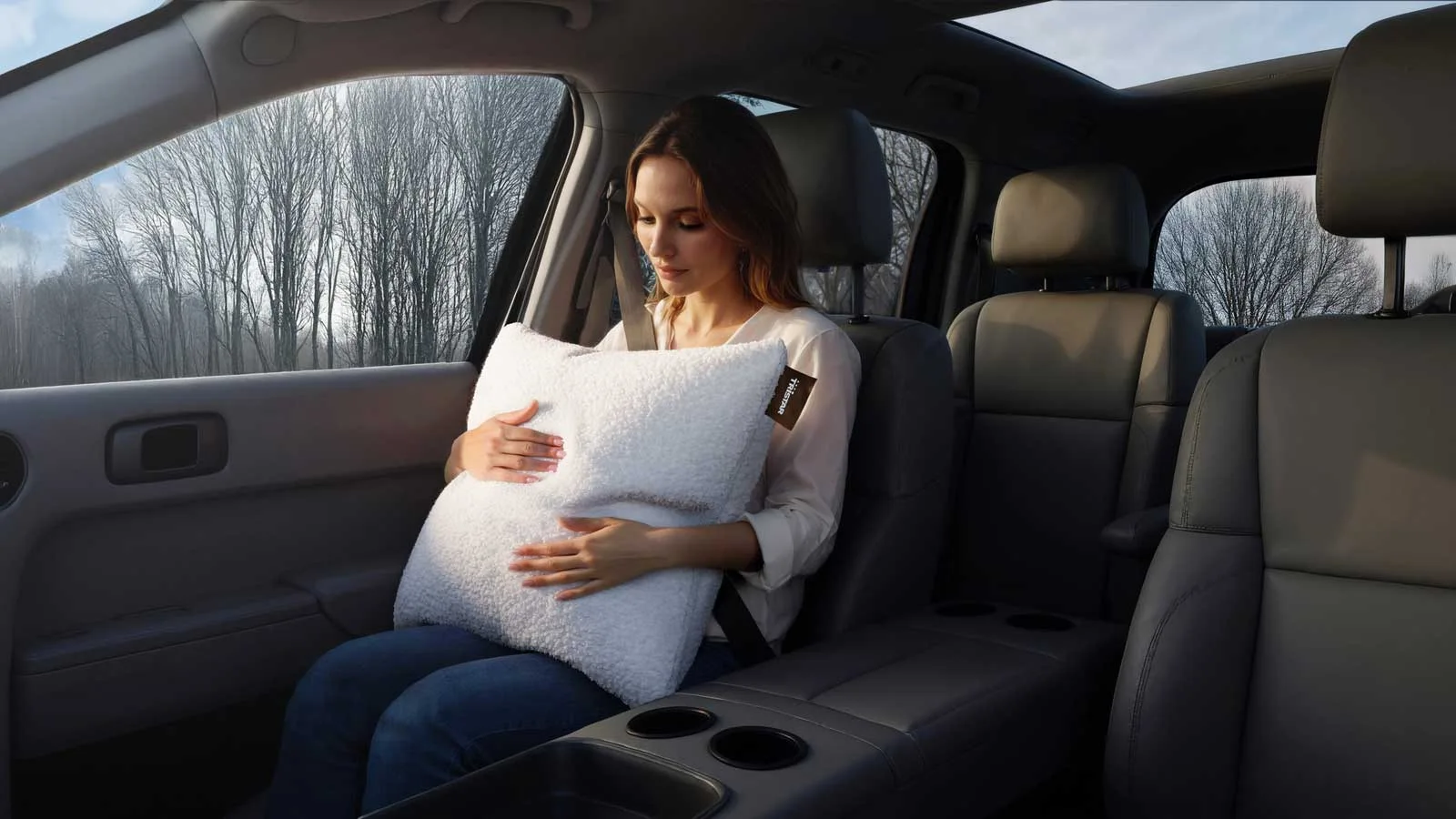
The hollow describes how the overall form bends. The small irregularities describe the character of its covering. Looking more closely at the brighter upper area, tiny light and dark marks give the surface a nubby appearance; farther down, that pattern continues into cooler shadow. It belongs to the curved object rather than appearing only as a decorative motif on its brightest face.
We do not need to identify the exact weave to notice the difference. Individual fibres are too small to judge reliably in this view. What remains visible is a fine layer of unevenness spread over a much larger, padded shape. Both levels contribute, and neither has to explain everything on its own.
The surrounding upholstery makes that distinction easier to see. The seats and armrest have broader, smoother areas of brightness, interrupted by seams and changes in form. Beside them, the pillow's many small marks feel more tactile. A surface acquires some of its character through the surfaces placed next to it.
This is a different scene from the sofa view, with a different position and light. It cannot isolate the effect of changing the fabric alone. It does, however, show why adding visible texture is only part of the task: the large bend through the pillow still gives that texture a form we can understand.
What a partly hidden pillow can tell us
The armchair scene changes the relationship again. The dark pillow stands between the seated figure and the back of the chair. Much of its face disappears behind the body, leaving an upper corner and a narrow area beside the lower back visible.
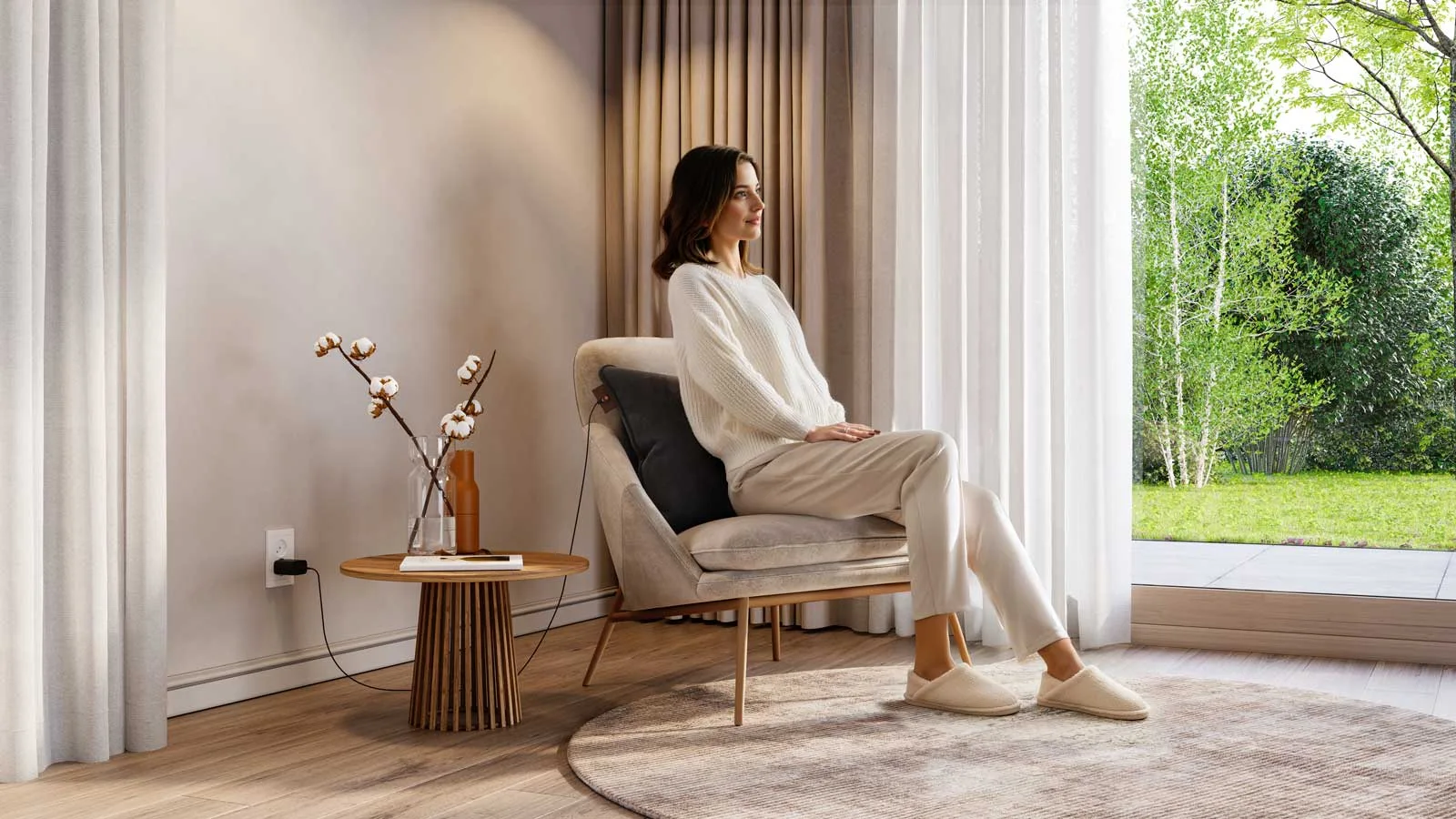
The remaining outline explains where the pillow sits. Its visible lower portion turns inward beside the body, while the upper corner holds a fuller shape against the chair. There is enough to read support, although far less to examine in the fabric itself.
Other textiles now do more of the work. The sweater has a visible knitted rhythm and bunches around the waist. The trousers form longer folds over the bent knee. At the window, the curtains fall in extended vertical lines. Each fabric takes a shape that relates to what supports it: a body, a joint or a hanging edge.
I find that difference more useful than a room filled with equally elaborate textures. The materials have distinct roles and distinct scales. The scene suggests comfort, but the image cannot tell us how comfortable the product actually is, or how its heating performs. Its strongest evidence is the visible relationship between bodies, cloth and furniture.
When looking at another digital textile, begin where it meets something: a wrist, a seat, the edge of a table. Follow the shape away from that contact, then examine the smaller marks on its surface. That route gives every wrinkle and patch of texture a reason to be there.
Visualizations by Without Camera, used with permission. Tristar Heated Electric Pillow is a series of lifestyle product visualizations of a Tristar heating pillow, created for Smartwares Europe and shown in domestic and car settings.