
Furniture That Makes Its Joints Part of the Design
Two pale plates turn at right angles over a pair of dark uprights. Small round fastener heads mark their faces, and a narrow gap separates the two halves. The arrangement has a clear order: across, down, then across again at the next level. Even in this tightly cropped view, the connections give us a way to follow the assembly.
Without Camera's visualizations of Flexbar, a folding mobile bar, bring that order into view. The exterior has broad decorative panels, but the closer images give the fittings their own presence. What interests me is how those small connections help us read the furniture as a collection of related parts.
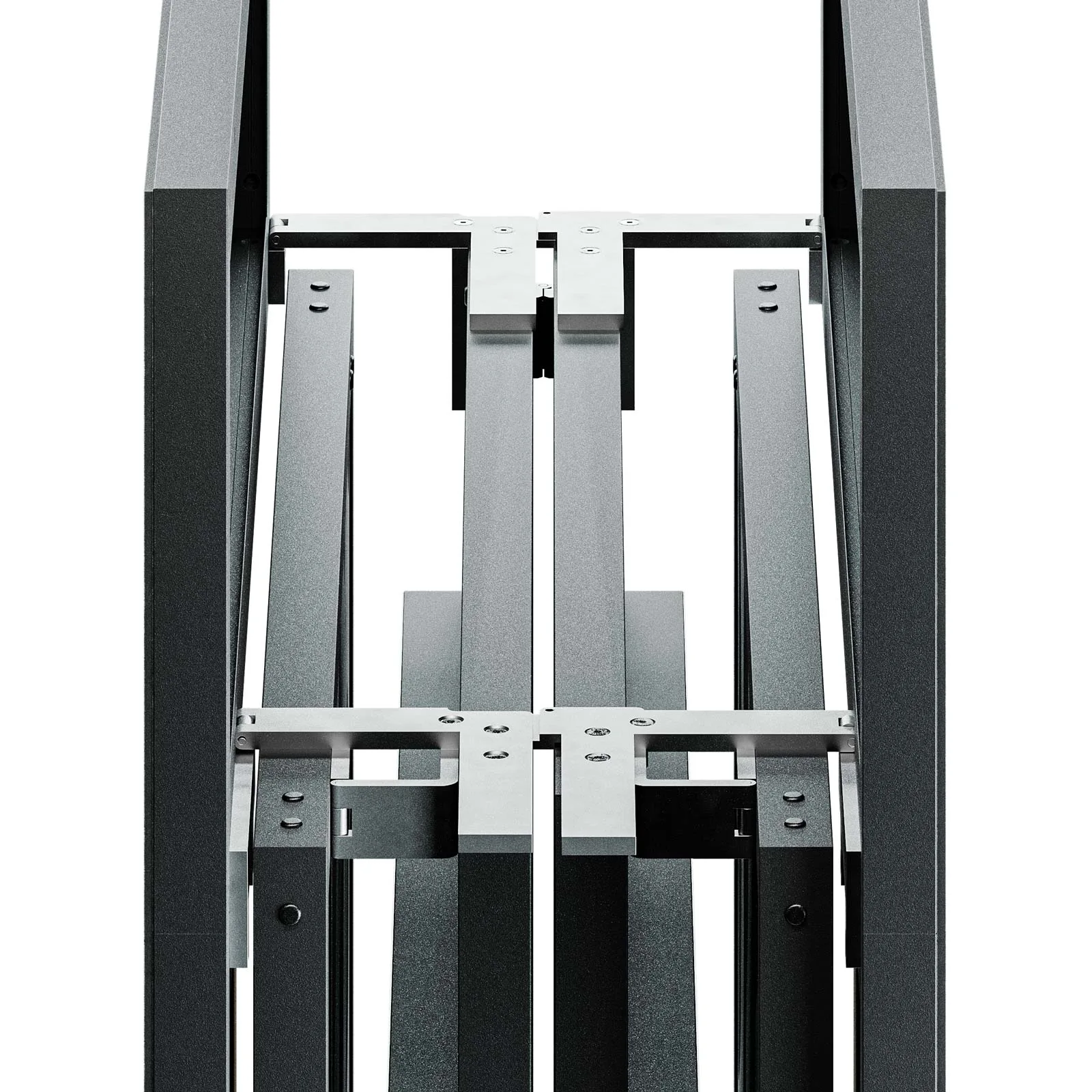
The plates are easy to distinguish because their bright faces sit against darker members. Thin shadows along their edges give them thickness. Below, bracket-like pieces turn away from the light, leaving dark faces beneath the pale horizontal lines. We can see layers rather than a single flat pattern.
The gaps matter just as much. White space remains between the outer frame and the members gathered towards the middle. That space allows the eye to follow individual edges without losing them in the assembly. At the centre, the narrow division keeps the paired fittings separate even though their shapes nearly mirror one another.
There is something satisfying about the placement of the fasteners here. Their small circles occur within the broader turns and intersections of the plates. They give the eye places to stop, examine a connection and continue along the next member. The detail has a visual rhythm that comes directly from the way its parts meet.
This is a useful amount of information for looking at the design. It is not enough to reconstruct the folding sequence: the crop leaves out the whole outline, and several components overlap. The image makes the arrangement legible while leaving the movement to be explained elsewhere.
Put the connection back into the furniture
A close-up can make a fitting look important simply by filling the frame with it. The view from the open service side gives us a more demanding test: do the visible connections still help explain the object when they become small?
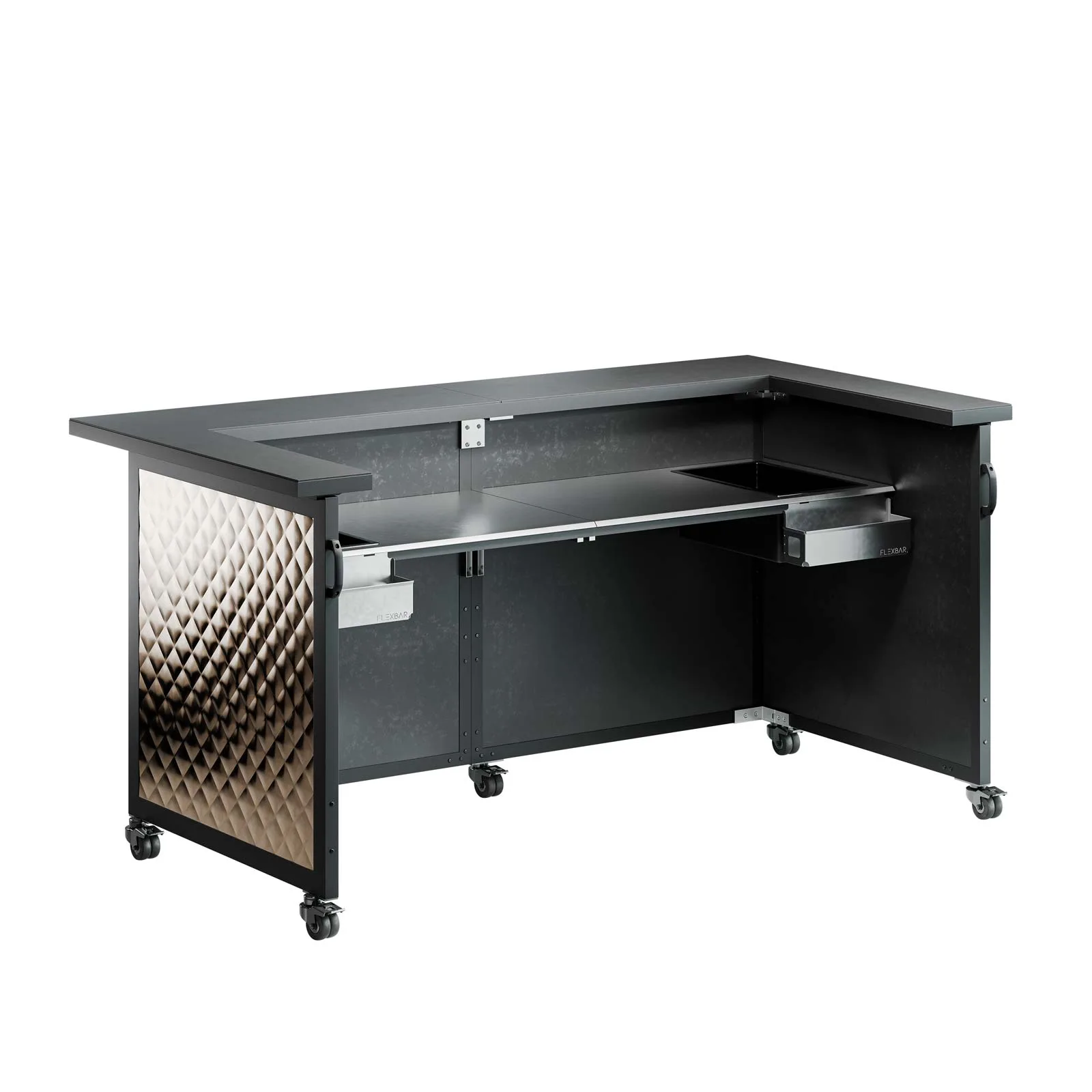
Here, the upper counter wraps around three sides, with a separate work surface below. On the far inner face, a small pale plate sits just beneath the upper counter, at the meeting of the two broad panel areas. In a larger view, we can also follow rows of dark fixing heads down the adjacent upright members towards the central wheel.
Those marks give the large surfaces boundaries we can understand. The plate makes one intersection conspicuous; the quieter rows below let us trace a longer connection. Their positions relate to the edges of the furniture, so they remain meaningful even when we can no longer inspect every head.
The contrast in scale is especially effective. Broad panels give the eye somewhere to rest, while a few fittings identify places worth examining. If every part carried the same density of detail as the folded close-up, that hierarchy would be harder to find. Here, the surrounding plain surfaces give the connections room.
The work surface still hides some of the assembly. We cannot match every piece in the first image to a visible part in this one. What the wider view supplies is the larger arrangement: counter above, working surface below, framed panels around them. The close detail now belongs to a piece of furniture with a readable interior.
A frame for the decorative surface
From the outside, the gold-coloured diamond pattern attracts attention first. Its many small reflections are held within much larger rectangles, outlined by the dark frame.
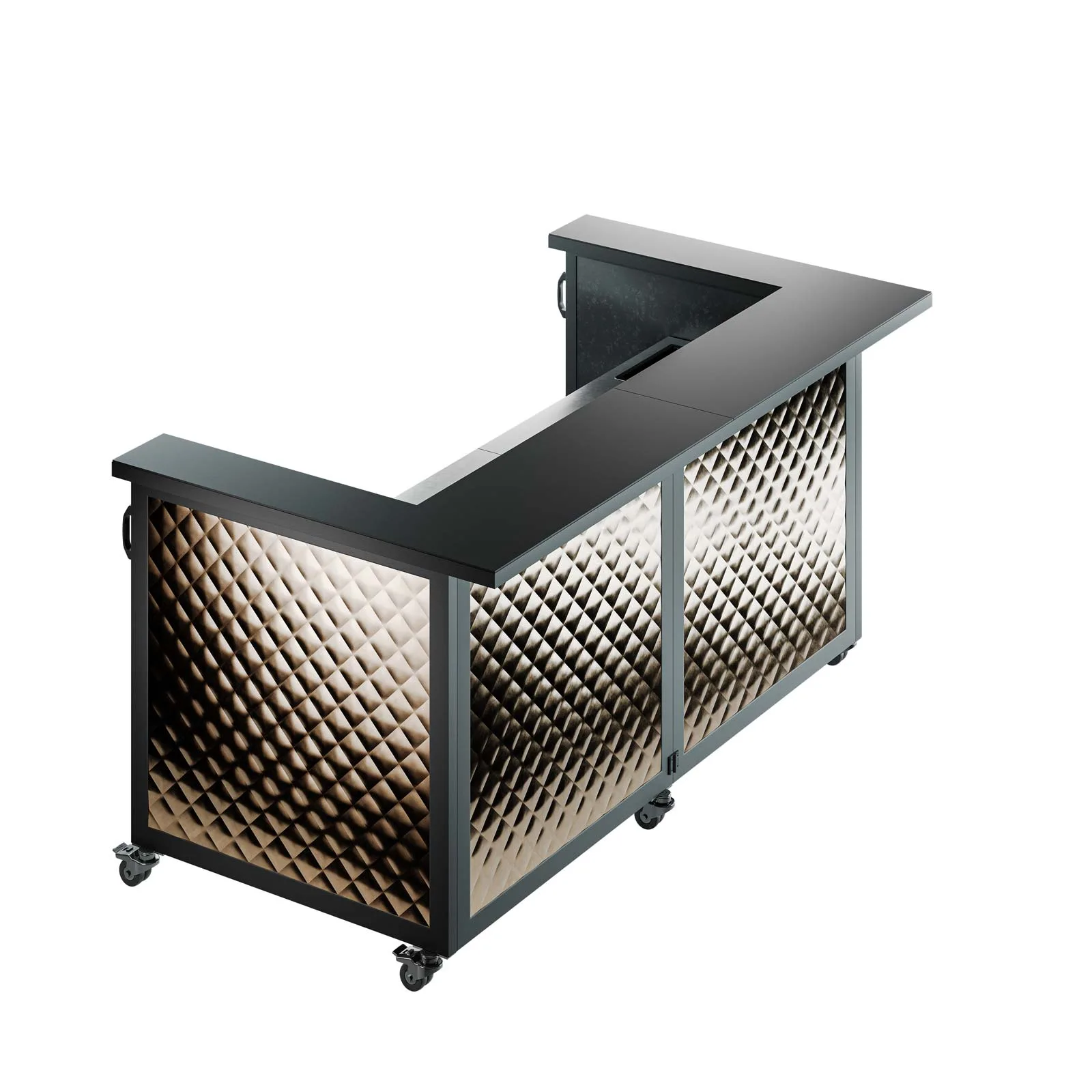
The upright near the middle interrupts the pattern and separates the front into two panels. A small hinge remains visible near its lower end. Above it, a fine line crosses the counter. These interruptions let us recognise separate elements within the otherwise continuous outline of the bar.
I like that the frame is broad enough to hold its own beside the busy surface. The diamonds supply a fine rhythm; the borders establish the larger divisions. The joint participates in that arrangement without needing to become its brightest feature. Much of the working hardware is tucked behind the panels, yet the exterior still acknowledges that the object has been assembled.
That relationship is worth looking for in other furniture renders. Find a connection, then follow the edges of the parts that meet there. A well-presented joint gives those edges somewhere to arrive. Its contribution can be modest—a plate against a plain face, a hinge at a panel division—but it changes how clearly we understand the whole.
Visualizations by Without Camera, used with permission. Flexbar – a foldable mobile bar is a series of product visualizations for Flexbar, showing a folding portable bar, its details and its use in different settings.