
The Highlight That Reveals a Product's Shape
My eye goes first to the fine silver lines running across the barbell sleeve. Each catches a little light before giving way to darkness. Together, they reveal a repeated pattern on a surface that remains almost black in places. A broader reflection near the top supplies another piece of information: how that surface curves.
These two images from Viscato's Weightlifting Barbell project for Gungnir of Norway offer a useful way to look at product lighting. In the close view, small reflections describe the surface. In the wider view, bright rims help us make sense of the larger form. Each gives light a different job.
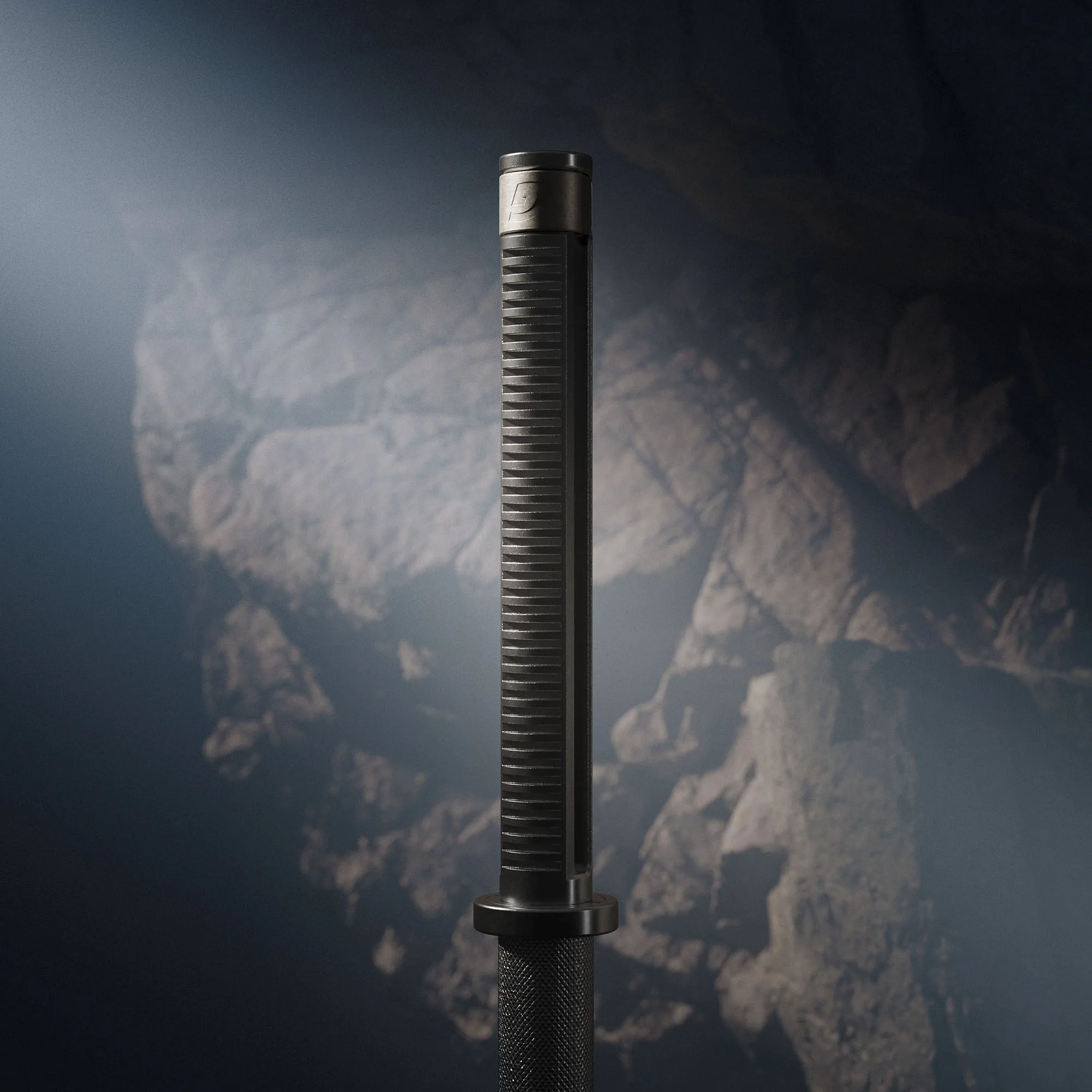
Reading the curve
Look at the smooth band just below the end cap. Its left side is relatively bright, while the surface becomes darker towards the right. That change helps us read the band as rounded. Farther down, the sleeve's closely spaced grooves break the light into smaller marks. We can follow their repetition without seeing every part of the surrounding metal equally clearly.
There is a simple principle behind this. For a smooth reflective surface, the direction of reflected light depends on the incoming light and the local orientation of the surface. Around a cylinder, that orientation changes continuously. Neighbouring areas can therefore reflect different parts of their surroundings towards the viewer, producing a bright strip beside a much darker region.
In this image, the broad reflection and the small bright edges contribute different kinds of information. The band near the cap suggests volume. The repeated marks below it make the surface pattern legible. Near the bottom of the sleeve, a thin highlight follows a projecting ring, or flange, helping us see where the diameter changes. A few carefully placed contrasts describe several parts of the object.
The background matters too. Its rock-like forms are irregular and softly defined, while the sleeve has crisp edges and a regular pattern. That difference gives the metal a clear visual presence without requiring the entire object to be bright.
What survives the wider view
The next image gives us more of the bar and a view down towards its upper end. At this distance, the fine surface pattern has less visual weight. The larger reflections become easier to notice.
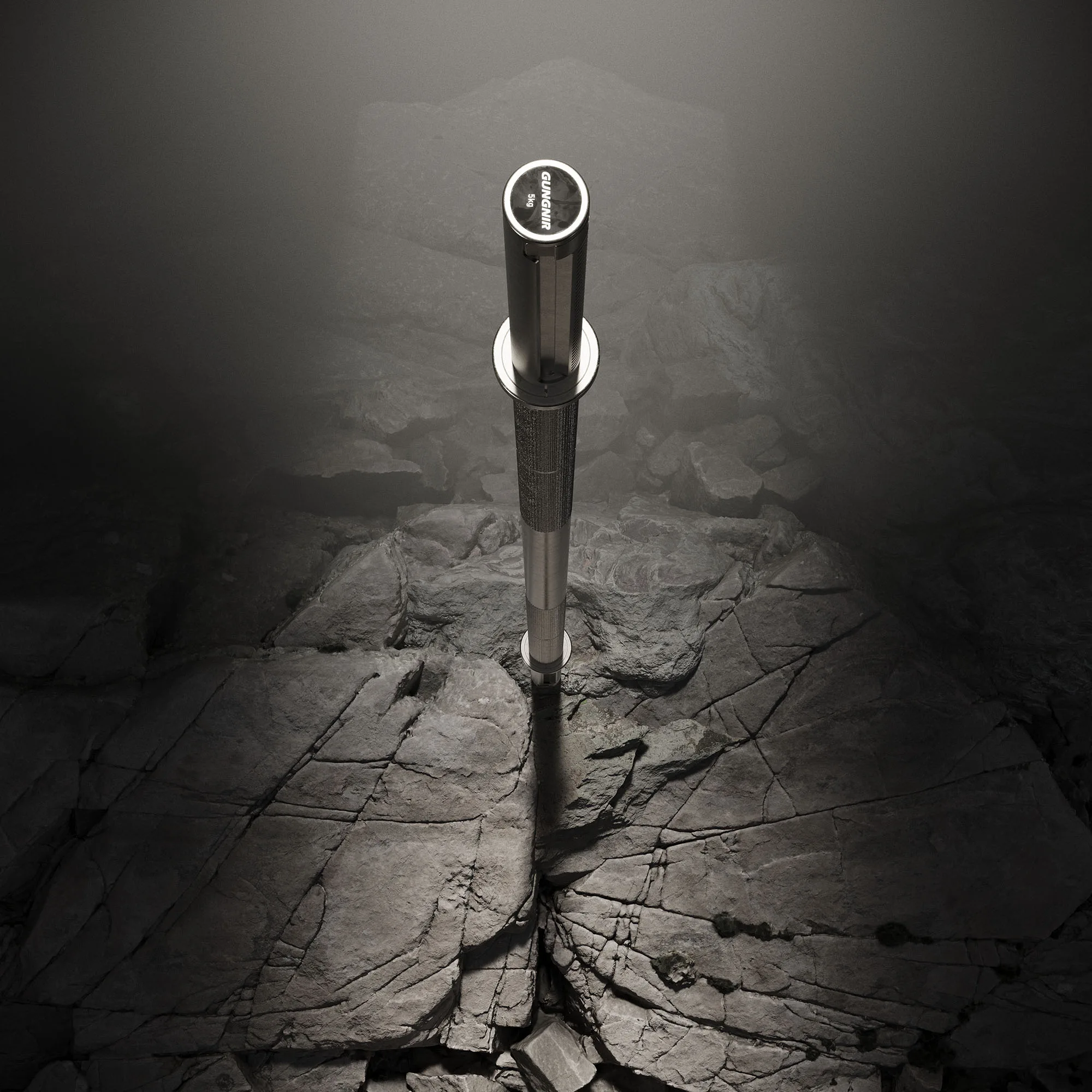
The bright rim around the end face is an immediate point of focus. Below it, the flange catches broad crescents of light on either side of the darker sleeve. Their elliptical outlines help us understand the angle from which we are looking at these circular parts. Farther down, a brighter stretch of shaft separates darker sections of the bar.
These highlights create a sequence along the product. The eye can move from the upper rim to the flange and then down the shaft, picking up changes in width and surface along the way. The fractured ground and cast shadow give that sequence a setting, while the brightest metal remains distinct from the surrounding grey.
I find the pair effective because the close view rewards inspection and the wider composition establishes relationships between components. The change in viewpoint also means different surfaces face the viewer. It is worth looking at what each frame explains individually before treating one as a more detailed version of the other.
How much darkness can the image afford?
Some information remains difficult to see. In the close view, the long recess on the sleeve's right side is largely dark. In the wider composition, the brilliant rims attract attention before the subtler surface between them. That hierarchy suits an atmospheric presentation, though a reader trying to inspect those features would need another view.
A useful way to judge a highlight is to follow it and ask what becomes understandable along its path. Here, one reflection describes a curve, another picks out a groove, and a third marks a change in diameter. Once those relationships are clear, even a mostly dark object can tell us a great deal about its shape.
Visualizations by Viscato, used with permission. Weightlifting Barbell is a series of product visualizations created for Gungnir of Norway, presenting the barbell's metal surfaces and details in a rocky setting.