
Rhythm and Repetition in 3D Composition
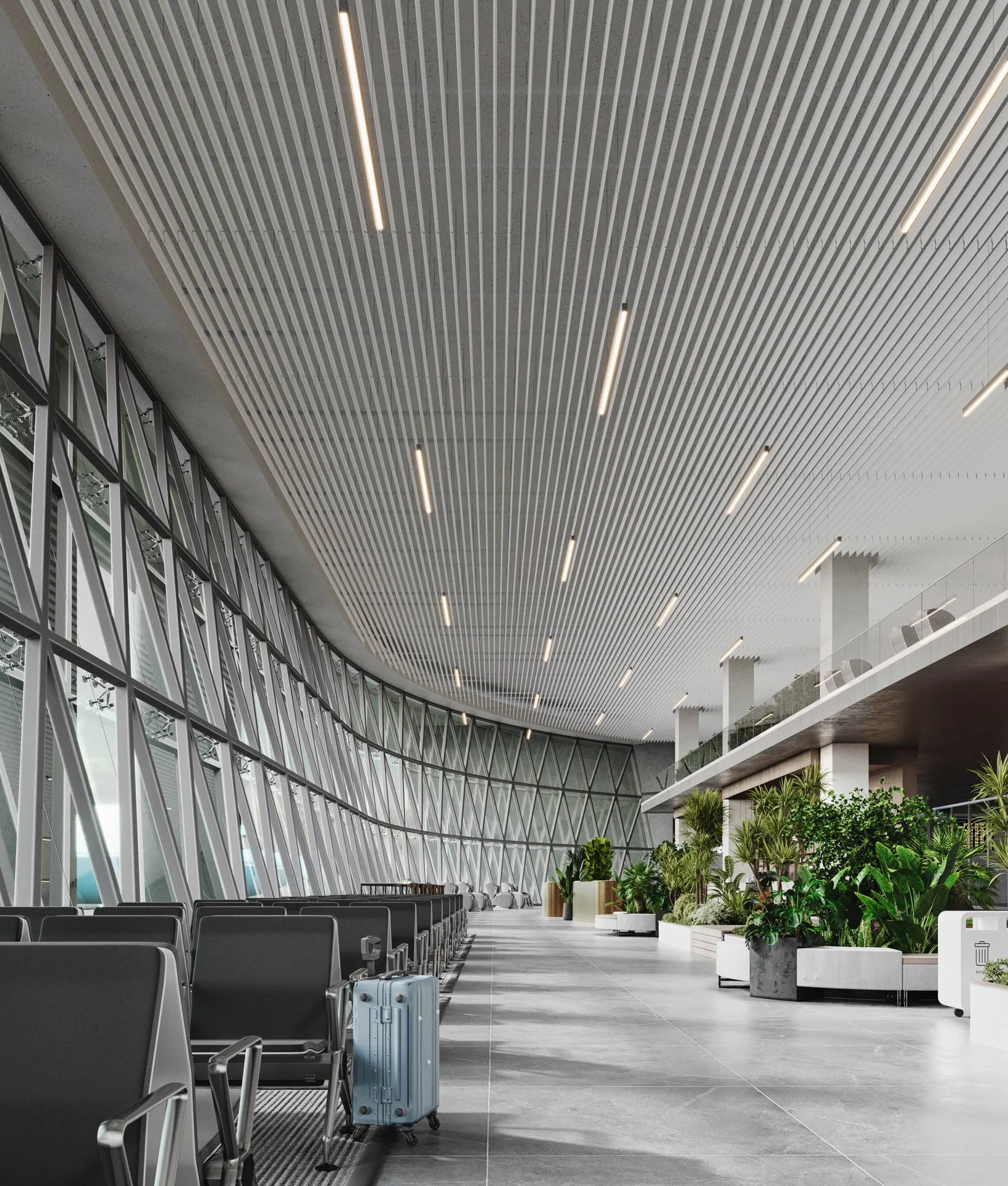
The nearest chair backs are large enough to examine individually. Farther along the hall, they overlap into a dark band. Above them, narrow ceiling fins gather into an increasingly dense pattern. These two sequences give the image a sense of distance before we have looked closely at the far end of the space.
The terminal interiors in Viscato's Ceiling Concepts project for Knauf Ceiling Solutions bring several kinds of repetition into one frame. Chairs, facade divisions and ceiling elements each have their own scale and spacing. Their relationships make a large interior easier to read, while the places where that regularity changes give us something to notice along the way.
Different intervals, one direction
Follow the line of the seats into the distance. The backs recur, their visible size decreases, and the gaps between them become harder to distinguish. Along the glazed wall, much larger diagonal members form another sequence. Overhead, the ceiling supplies a finer pattern of pale edges and darker spaces.
We can think of these as three rhythms within the composition. Each depends on a recurring form and the interval before it appears again. The ceiling establishes a dense field, the facade divides the wall into larger sections, and the seats bring repetition down to the scale of a familiar object. Together they give the eye several ways to travel through the hall.
Their apparent spacing changes as they recede. Near the camera, individual ceiling elements are easy to separate; towards the far end, the pattern becomes more tightly packed in the image. That progression helps us read the extent of the ceiling. The chairs provide a similar cue closer to the floor, reinforcing the depth without requiring us to know a single dimension.
The lights add a different emphasis. Their bright strips appear at intervals within the much denser ceiling pattern, making particular locations stand out. There is enough continuity to follow the surface and enough variation to keep it from becoming an undifferentiated field of lines.
From rows to places
At the lower viewpoint, the nearby seats hide much of the arrangement behind them. The view from the upper level makes the larger groups easier to distinguish. It also reveals how the regular rows sit beside areas with a different character.
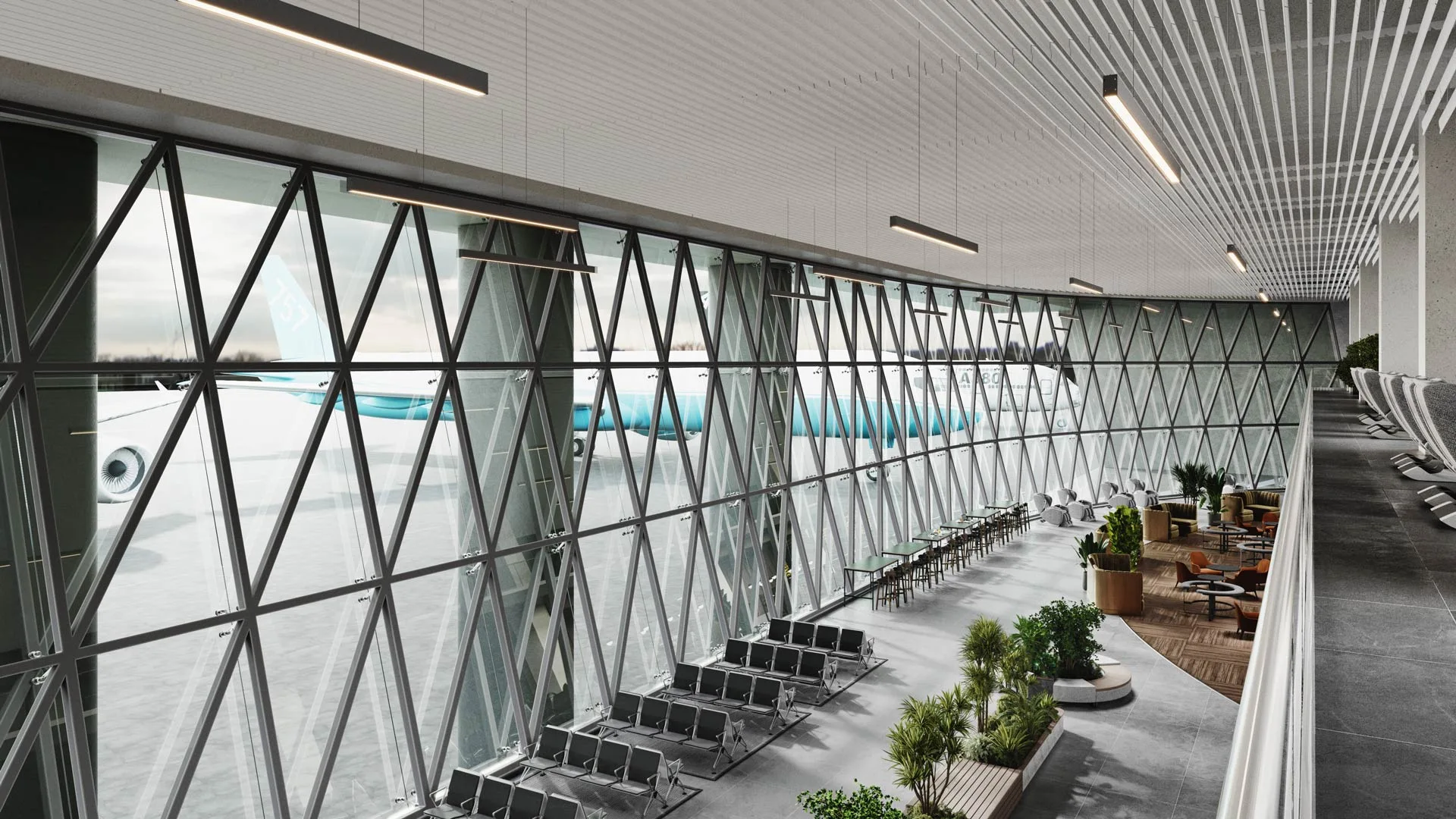
The dark seats now read as separate banks, with visible gaps between them. Farther along the glass, a line of tall tables and stools introduces a smaller repeated unit. The facade continues behind both, while the ceiling extends above them. We can understand these groups as parts of one hall even as the furniture changes.
On the lower right, the arrangement becomes less regular. Curved planted benches meet the grey floor, and a warmer timber-patterned surface marks the lounge area. Small tables and orange and brown seats form looser clusters. The leaves vary in height and outline, giving this part of the image a different texture from the rows beside the glazing.
The composition gives the eye somewhere to pause. After following so many repeated edges, the curved bench and uneven planting are easy to register as a change. Their effect depends partly on the order around them: we have already learned what repeats, so a different shape or grouping becomes meaningful.
What the pattern lets us notice
I prefer the lower view for understanding the ceiling's presence overhead. Its portrait framing gives the fins room to dominate, with the seats and suitcase anchoring the scale below. The elevated view is more useful for understanding the relationship between waiting areas. Here, the strong facade pattern and the aircraft beyond it also draw attention, and the ceiling becomes one part of a broader composition.
This is a useful choice to recognise when composing a render. A repeated element can be the subject of an image or provide continuity behind other subjects. In these views, the ceiling holds together areas whose furniture, planting and floor treatment vary. The variation below gives that continuity something to connect.
To judge repetition in another image, trace one recurring element from the foreground into the distance, then look for the point where the arrangement changes. Does that change reveal a distinct place, a different use or a useful focal point? Here, the steady sequence makes the planted edges and lounge area more legible. The rhythm helps us understand both how the hall continues and where it becomes different.
Visualizations by Viscato, used with permission. Ceiling Concepts is a visualization project for Knauf Ceiling Solutions, presenting ceiling systems in large public interiors, including airport settings.