
How to Suggest Human Presence Without Showing People
The recipe book is still open, although a bowl of soup is already on the counter. Between the two, it is easy to imagine someone checking a page, preparing the vegetables and reaching for the blender. The image gives us those possibilities without showing a single hand.
In Viscato's Princess Handblender visualizations for Smartwares, familiar kitchen objects make the product part of an activity. What interests me is how much of that activity we can infer from the relationships between things. A recipe, a tool and a meal give each other meaning when they share the same worktop.
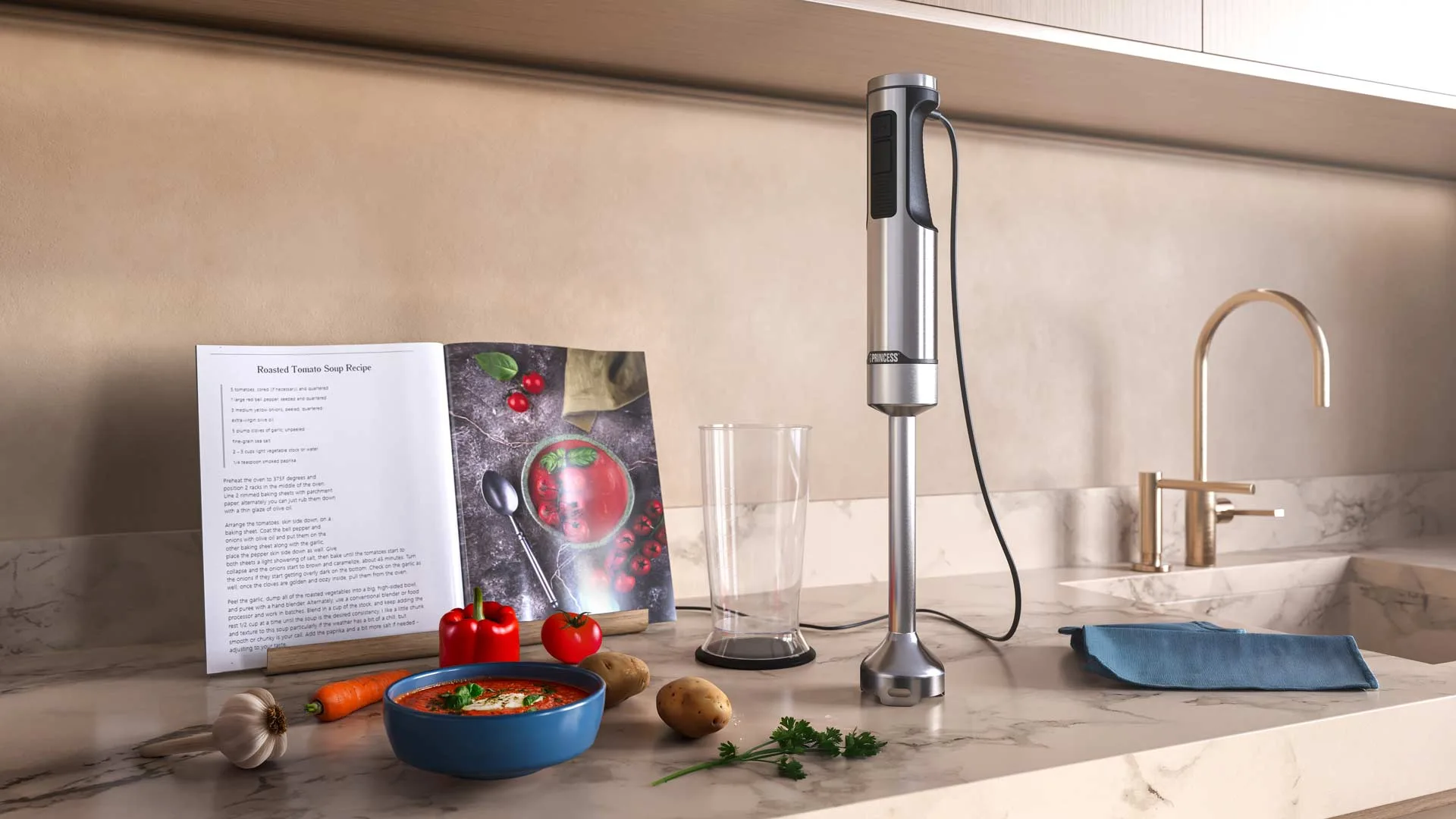
The open page gives the objects a purpose
The book is propped up on the left, facing out towards the space where a cook might stand. Its open spread shows a tomato soup recipe and a photograph of the dish. In front of it, the vegetables and the red soup in a blue bowl carry that subject into the kitchen. The upright blender and clear beaker complete a set of objects we can connect through preparing food.
The detail that matters is the book's state. A closed cookbook could belong to the room as a possession. An open one, positioned to be read, suggests a possible action. The loose ingredients offer another: something could be picked up and prepared. None of these objects needs a person beside it for the arrangement to suggest use.
There is also a small compression of time here. Raw ingredients, an empty beaker and a finished-looking bowl of soup occupy the counter together. We can read them as preparation, equipment and result, though the image does not establish a literal sequence. It offers enough information to imagine making a meal while leaving the exact moment unsettled.
Around the blender, the arrangement becomes quieter. Its tall silhouette stands against a relatively plain wall, and the blue cloth sits apart by the sink. The kitchen context is specific, yet the appliance remains easy to inspect. The suggestion of a cook shares the frame with a clear product presentation.
A tool set down leaves an action unfinished
Another composition brings the ingredients closer and places the blender on its side. This changes the kind of moment we might imagine. The device looks available to be picked up again, with its handle farther back and its blending head facing towards us.
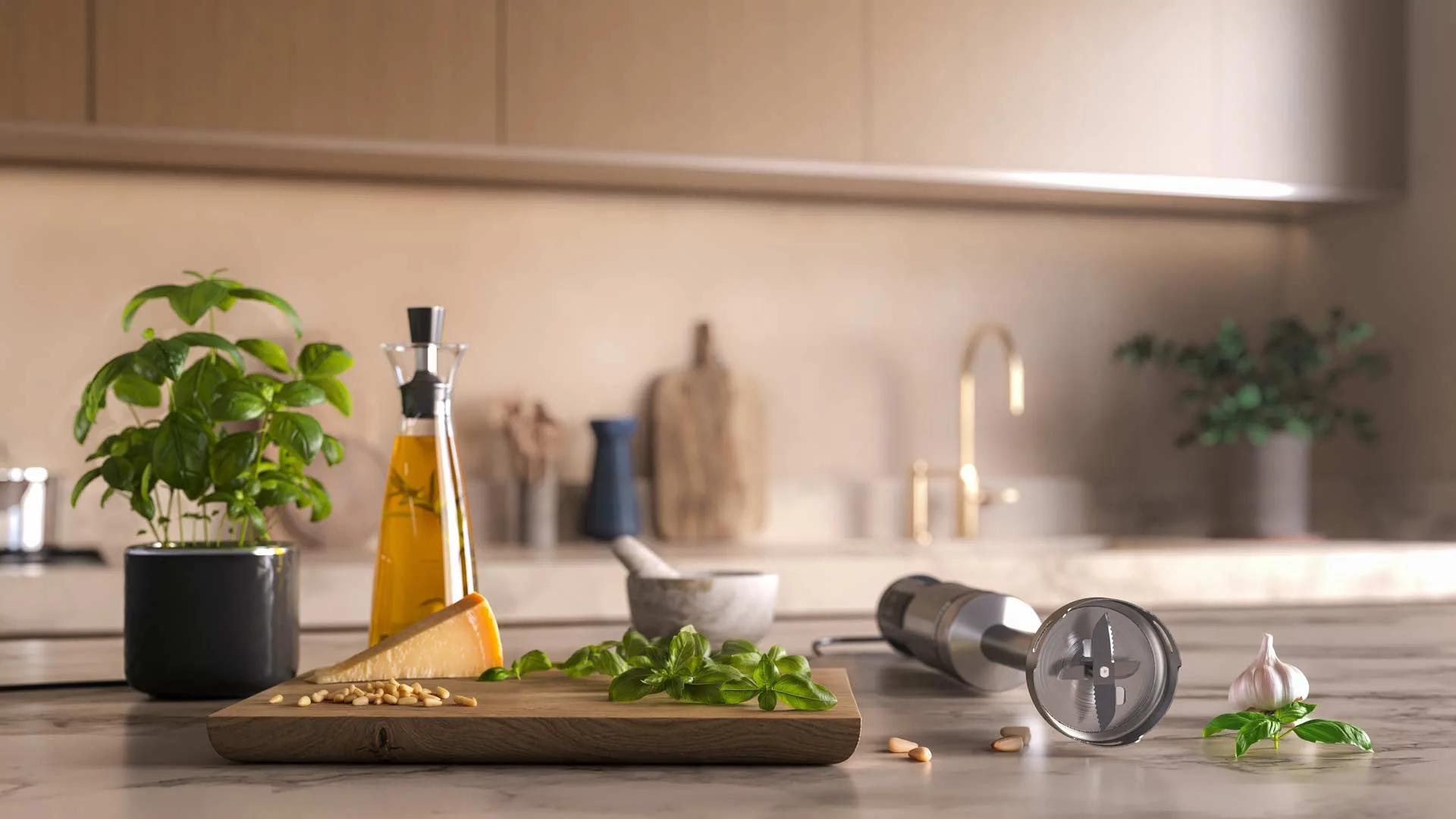
The basil, cheese, pale nuts, garlic and bottle of golden liquid suggest pesto. A potted herb stands beside loose leaves spread across the board, giving us both an ingredient within reach and a portion laid out for use. A few nuts extend beyond the board onto the counter. Their placement loosens the boundary of the preparation area without making the surface look heavily cluttered.
There is a hint of everyday life in that small spill beyond the board. It connects the tidy group of ingredients to the surface around it. Together with the horizontal blender, it suggests a pause within an activity. We might imagine a hand returning to the handle or gathering the remaining ingredients.
The same position also exposes the appliance's blade and guard clearly. That is part of the image's ambiguity: a tool can appear casually set down while being presented from a highly informative angle. The implied pause makes the product approachable, even though the composition remains carefully arranged.
Leave room for the person we cannot see
I find these scenes convincing as invitations to imagine cooking, though neither gives us much evidence of actual work in progress. The surfaces are clean, the ingredients clearly separated and the product unobscured. In the second image, the mortar and pestle introduce another possible way to prepare the ingredients. The scene leaves us to decide which tool someone might reach for.
That openness suits the idea of an absent person. We can imagine an action without being given a character, an exact recipe or a complete account of what happened. More props would only help if they made those possibilities clearer. An unrelated object could fill the counter while contributing very little to the activity we are reading.
When choosing objects for a scene like this, consider what each one lets a person do next. An open page can be consulted, loose leaves can be gathered, and a handle can be picked up. Human presence begins to emerge when those possible actions belong together.
Visualizations by Viscato, used with permission. Princess Handblender is a product visualization project for Smartwares, presenting the appliance in kitchen settings with food and preparation utensils.