
Wood in 3D: Why Grain Direction and Scale Matter
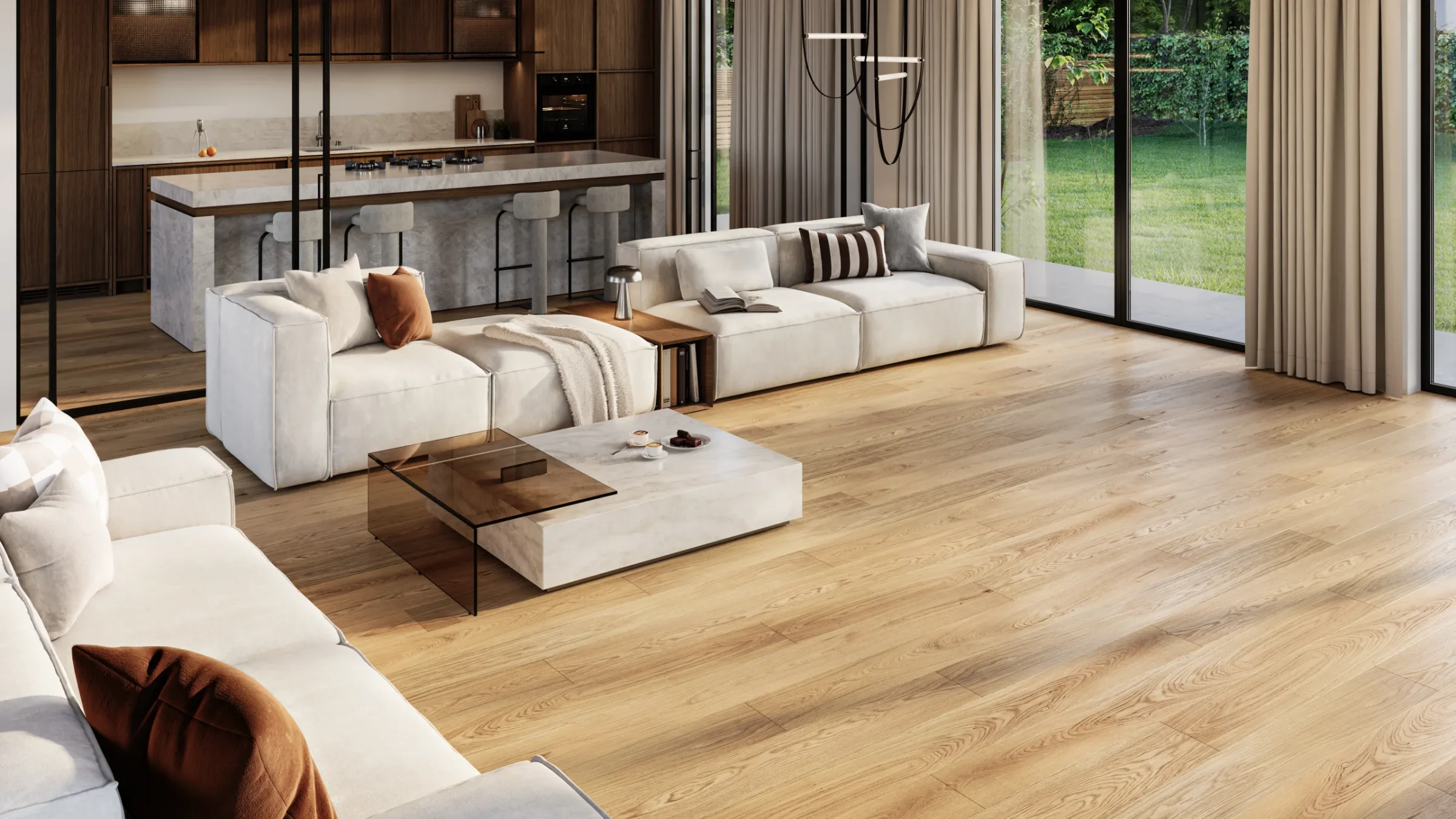
A short joint interrupts the floor near the coffee table. It is easy to overlook among the longer lines of the wood, yet it gives us something useful: the end of a piece. Once that boundary becomes visible, the grain has a direction and a size we can judge against it.
In Viscato's flooring visualizations for GBP Bergamo Parquet, the open space around the furniture makes this relationship unusually accessible. We can follow a pattern inside one board, then look up to see how that board fits into the room. That movement between detail and context is where I would begin assessing the material.
Direction belongs to the piece
In the exposed foreground, the grain opens into long, nested curves. Their lines wander, but their overall movement follows the length of the boards. The straight seams give that movement a boundary; the short end joints divide it into separate pieces. We can read both the surface pattern and the assembly carrying it.
This is a useful distinction when looking at digital wood. Imagine keeping those board edges exactly where they are while turning the grain across them. The floor would retain its layout, but the relationship between each long strip and its markings would change. That is a hypothetical adjustment, yet it helps explain why orientation deserves attention of its own.
There is another direction in the same image. On the tall kitchen fronts at the back, visible wood markings rise vertically. The floor's grain runs along the floorboards, while the cabinetry gives the pattern a different frame. Each surface can have its own orientation and still belong comfortably in the same room. The detail to examine is how the markings relate to the element they cover.
The joints matter as much as the longer lines. In the floor foreground, neighbouring boards carry different figures and tones. Those small changes help the pieces remain distinct while sharing a broad direction. For me, this is where the material becomes persuasive: there is enough variation to invite a closer look, with clear boundaries to make sense of it.
How much of a board does the pattern occupy?
Scale asks a different question. A grain curve can be beautifully detailed, but we still need to judge its size against the surface carrying it. The more downward view of the lounge below makes that comparison easier, because the floor remains exposed around the separate chair and low table.
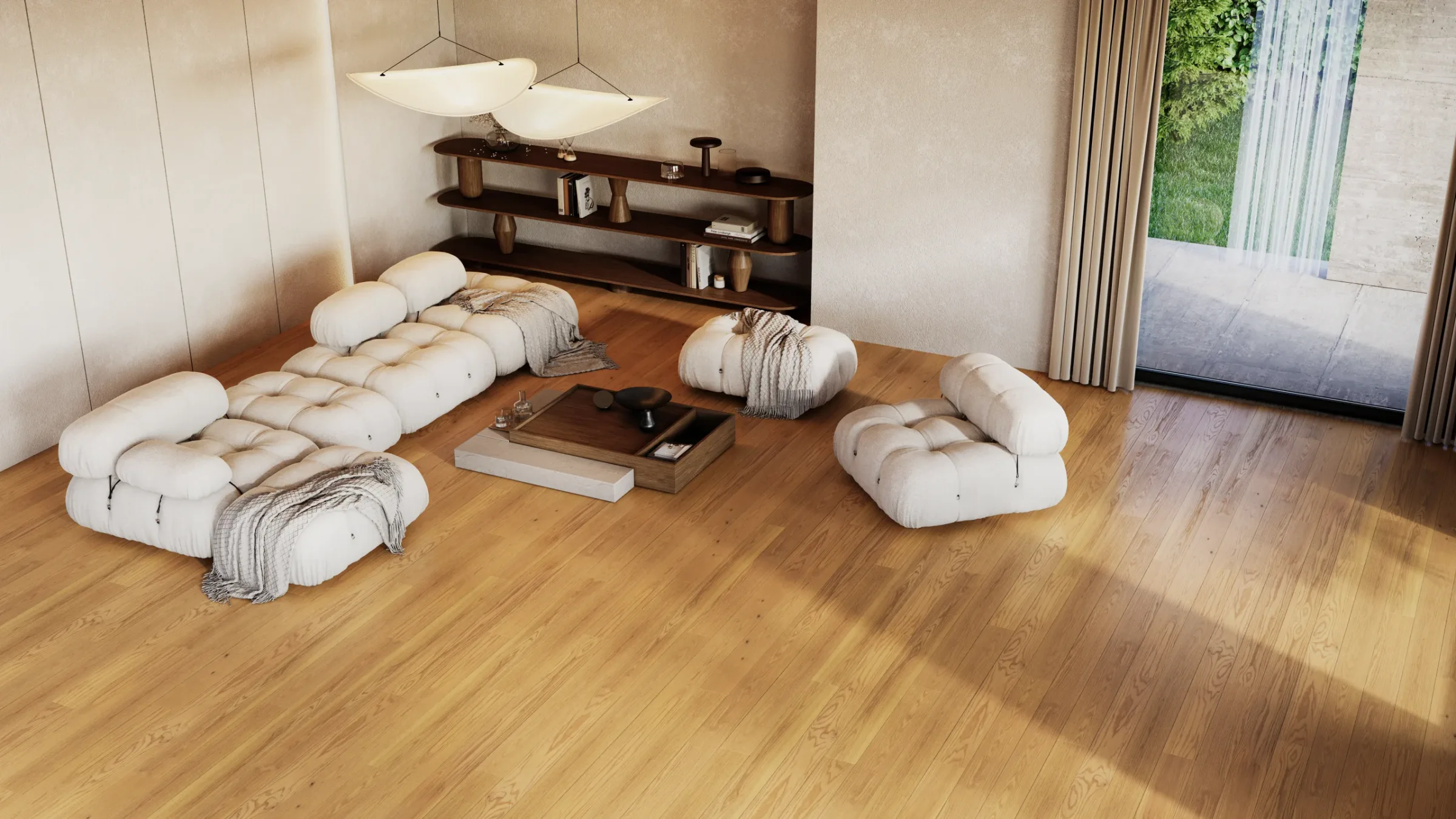
Look at one of the nearer strips, where its two long edges can be followed. Some markings occupy a narrow passage within the board; others spread into broader curves. The board width gives those differences a reference. From there, the chair's footprint provides another: several strips fit beneath and around a familiar object.
That chain of relationships makes scale readable. We move from a line within a grain figure to the width of a board, then to the furniture standing on the floor. No exact dimensions are supplied here, so the judgment remains one of visual proportion. A useful question is whether these levels feel consistent with each other.
Imagine enlarging only the grain pattern while leaving the boards and furniture unchanged. A curve that once occupied a small part of a strip could come to dominate its width. The room would be the same size, but the wood would suggest a different relationship between pattern and piece. This thought experiment concerns the size of the markings; making them darker would change their prominence without necessarily changing their size.
In 3D work, texture placement gives an artist control over such relationships. The Blender manual's Mapping Node reference, for example, describes rotation and scaling of texture coordinates. The general principle is useful even to someone who never opens the software: choosing a wood texture still leaves decisions about how it sits on a surface. These finished images let us examine the result, without revealing the settings used to produce it.
I would return to a joint before asking for more surface detail. Can I tell where the piece ends, how the grain travels through it and how large its markings appear beside the things around it? A convincing material gives those questions compatible answers. The small seam near the table helps us see why.
Visualizations by Viscato, used with permission. Premium wood flooring — Bergamo Parquet collection presents flooring decors in furnished residential interiors for GBP Bergamo Parquet.